Showing posts with label farming. Show all posts

Saturday, April 11, 2009

Deforestation of the Amazon rainforests

Deforestation of the Amazon rainforests:
There is no such species rich rainforest on the earth as the Amazon rainforest in northern South America, but there is also no rainforest where the deforestation is so massive and also so well visible from satellite images. The jungle here is typically cleared to provide pasture for cattle, then soy farmers move in later, and after the soy is not profitable anymore they cultivate their crops. In all the state that are part of the Amazone forest the deforestation is best visible in the state of Mato Grosso in Brazil. 48 percent of Amazon deforestation that took place last years occurred in Mato Grosso. Take for example this satellite image from google earth:


In 1992 this was one big forest, but now you see that the dark green color of the wood is largely taken over by agriculture. This is also the case in the state of Rondonia in Brazil. About 50 percent of the Amazon forest is felled here during the past 20 years:


The States of Amazonas and Para that cover most of the amazon forest are still largely covered by forest. But also here are large-scale logging projects going on. This happens usually along a main road from where the rain forest continues to be cut away. This creates an elongated form as you can see in the picture below in the state of Para:


In the picture below you can see this deforestation process in an earlier state in the Amazone state of Brazil:


In eastern Bolivia this deforestation is also done in some sort of agriculture circular crops to get the most efficient possible format for the farmers:


Not only humans are responsible for the deforestation of the Amazone forest. Often large forest fires occure. The most notable was the "Great Fire" that occurred in Roraima in 1998 and whose scars are still visible in the landscape:


The area in the picture above measures about 70 km by 120 km. This natural process is ,contrary to human logging, of course not damaging for the forest in the long term. If the human deforestation of this forest goes on in the same rate as now the Amazone rain forest will be 85% gone in the next 100 years. This could cause much more extreme weather on the planet and would contribute to the global warming. And maybe even more worse the loss of countless species and potential drugs against various diseases.

Read more...

Monday, March 30, 2009

Floating fish farms

Floating fish farms:
A floating sea fish farm is used to breed sea fish.
These floating fish farms are especially common in Asia and they come together in large numbers mainly at the coasts of China and Japan. These Chinese floating fish farms consist of a floating raft with different "fish pens". Each of these rafts generally have their own house on it for the owner. In the pictures below you can see such typical Chinese fish farms:


When they are together in large numbers it look's like a floating village:


The biggest number of floating fish farms close together in the world are found not far from the city of Shantou in China. At this point these farms stretch for almost 12 kilometres. Thousands of such farms are floating in the water here:


Each of these fish farms you see in the pictures below are generally 30 by 30 metres but sometimes they are almost 250 metres long:


The chain of floating fish farms at this bay "begings" here and ends all the way here (12 kilometres further). The formations can sometimes be very chaotic, and there seems not to be really thought of a logical structure:


If you wonder how they reach these farms take a look here where you can see all the boats used to reach the farms.
Another place i found where a lot of them float together is here (Not far from Xiamen):


This farming complex stretches for almost 5 kilometres. At the coasts of the fish eating country number one; Japan they also use these floating fish farms a lot. Al though they look different from the Chinese ones. They don't have the small houses on it and they generally use nets in Japan which are supported by floating circle-shaped or rectangular girders. Like you can see in this bay in Southern Japan:

Read more...

Friday, March 27, 2009

Agriculture terraces

Rice terraces:
In agriculture, a terrace is a leveled section of a hilly cultivated area, designed as a method of soil conservation to slow or prevent the rapid surface runoff of irrigation water. Often such land is formed into multiple terraces, giving a stepped appearance. The most common crop on these terraces is rice. Nowhere in the world such spectacular agriculture terraces (rice terrases in this case) are found as in the Philippine Cordilleras. The philipinne Cordilleras is a mountain range in northern Philipinne. The most spectacular and most famous rice terraces here are the ones around the village of Banaue. The Rice Terraces here are commonly referred to by Filipinos as the "Eighth Wonder of the World". This is no surprise if you see the pictures below:


There are many other rice terraces in the Philipinne Cordilleras. Like here near Batad:


Agriculture terraces are common in whole South-East Asia and especially in southern China.
The rice terraces built by the Hani nationality in Yuanyang County in China are a little known scenic wonder in South-West China's Yunnan province. Dropping from near the summits of the 2500 metre Ailao Mountain Range to the deep cleft of the Red River, they are among the world's most spectacular and extensive terraces:


Here near the town of Longshen in the Guanxi province in China another large area of rice terraces is situated:


In Vietnam there are also many big rice terrace projects. Here near Sa Pa in Vietnam for example:


In Peru, the Inca made use of otherwise unusable slopes by drystone walling to create terraces. The most famous they made are at the site of Inca town of Machu Picchu. These are really steep terraces:


Read more...

Thursday, March 26, 2009

Khofra farming communities

Kufra farming communities:
Khofra is a town in Libya in the middle of the Sahara desert. The water to this town is supplied by an underground water network. When you are tied to an underground channel of water, you’re encouraged to make efficient use of space. This effient use of space is perfectly seen in the farming communities near this city you can see below. It for sure makes a very special seight seen from the sky:


These hexagonal shaped communities consist of a central square surrounded by sixteen farms.
This way these communities are able to efficiently deliver water to each farmer because on this central square the water for all the farmers is supplied by some sort of an underground well where the underground water network is attached to. The land of each farmer stretches out for 500 meters behind their farm :


In total there are 15 of these communities, and they are building more of them as you can see here.

Read more...

Tuesday, March 24, 2009

Seaweed farms

Seaweed farming:
Seaweed is a loose colloquial term encompassing macroscopic, multicellular, benthic marine algae.
The ecology of seaweeds is dominated by two specific environmental requirements. These are the presence of seawater (or at least brackish water) and the presence of light sufficient to drive photosynthesis. A very common requirement is also to have a firm point of attachment. As a result, seaweeds are most commonly found in the littoral zone and within that zone more frequently on rocky shores than on sand or shingle. Seaweeds are used as food, medicines, fertilizers,and for industrial purposes. Seaweeds are extensively used as food by coastal people, particularly in East Asia, e.g. Japan, China, Korea, Taiwan, and Vietnam, but also in Indonesia, Peru, the Canadian Maritimes, Scandinavia, Ireland, Wales, Philippines, and Scotland, among other places. Seaweed is very common in most oceans and sea's, but is also farmed in so called seaweed farms. This is done on small plots ( floating nets ) floating in the water ( most of the time in a bay ), where the seaweed is attached on.

These seaweed farms can be huge and can excist of thousands of these floating seaweed plots. Here in China for example a very big seaweed farm is situated:


The biggest in the world is situated in the Jiaozhou Bay near Qingdao in China. This particular seaweed farm is producing almost half of the total global seaweed production. This farm isn't using these typical floating plot's but is using some kind of underwater nets where the seaweed is attached to:


Seaweed farms are also very common in the bay of Tokyo. The biggest in this area is this one:


Each plot you see in the picture above is 100 meters long and the dimensions of the total farm is 6km by 4km. Here is another seaweed farm in China. This farm is situated near a tidal area as you can see in the picture below:

Read more...

Friday, March 6, 2009

Center pivot irrigation

Center pivot irrigation:
In an area with a dry climate center pivot irrigation is often used . This way it is possible to have agriculture. This method of agricultural irrigation results in a circular field of crops. A huge column of sprinklers, fixed to the ground at one end, slowly travels around in a circle whilst spraying the crops below:


The system is common all over the world but it is especially used in parts of the United States, Australia, New Zealand, and in desert areas in the Sahara and the Middle East. There is no place on earth where these kind of crops are more numerous then in the dry mid-west of the U.S. Like for example here in Texas, or here in Kansas.

More special is it when these crops are in the middle of a desert, like
here in Jordan:


or here in Lybia in the Sahara. The water for this project is stored in giant water tanks:


and here in the Sahara in Lybia:


Very large desert irrigation projects are situated here in southeastern Libya which is called the Al Khufrah Oasis ( This is one of the largest agricultural projects in a desert area) and here in the desert of Saudi Arabia.


Read more...

Wednesday, February 25, 2009

The Northern Chinese plain

The Northern Chinese plain:
The Northern Chinese plain in China is one of the most densly populated rural area's in the world. The plain covers an area of about 409,500 square kilometers where approximately 600 million people live. The Nortern Chinese plain is the dark green area below the city of Beijing on the map shown below:


Beneath you can also see a map of the population density of China. The Northern Chinese plain is recognized easily by the red area on the North east coast of China. The density is higher then 445 people per square kilometer in most parts:


About 80 percent of the people on the Northern Chinese plain live in small, rural villages, and work on the land. The rest lives in overcrowded cities, where housing is scarce. Although this percentage living in villages is decreasing at a huge rate, due to urbanisation.

On the North China Plain, villages are fairly evenly distributed and are connected with one another by footpaths and cart tracks. Most of the villages are closer then 2000m from each other. This way these villages form a grid of villages all across the Chinese plain. This can for example be seen here
in the Hebei province, here in the Henan province, and here in the Shandong province. These patterns of villages can be seen everywhere on the Northern Chinese plain in this type of density and in these patterns:


The Houses in these villages are built close together and are mostly made of sun-dried brick or pounded earth. Many of the market towns or even large villages are surrounded by walls. The formation of these villages is related not only to the increasing population and to a long historical background but also to water supply (the practice of drilling deep wells, for instance) and to defense (especially, in former days, against attack by bandits). Many of the large villages have no urban atmosphere at all, even with populations of several thousand.

Read more...

Saturday, January 17, 2009

The Feedlots of the USA

Feedlots:
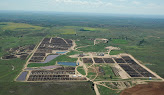
A feedlot or feedyard is a type of Confined Animal Feeding Operation which is used for finishing livestock, notably beef cattle, prior to slaughter. They may contain thousands of animals in an array of pens. In the picture below the size of a big feedlot in the USA can be seen:


The feedlot, developed post World War II in the United States due to the rise of fast food operations, enables the cattle to gain weight faster through grain feeding and protein supplements, in order that the cattle may reach mature slaughter weight at a much faster rate than traditional grazing methods, while taking up less area than required in traditional grazing methods. The feedlot system, however, displaces cattle from a species-appropriate environment into a confined area where feeding takes place through mechanized trough-like systems. The feedlot also relies on a grain-fed method to fatten the cattle, disregarding the cattle's ruminary nature:


While feedlot systems provide inexpensive and readily available meats to supply the world's high beef demand, pasture-fed beef becomes a more sustainable system for the environment. The feedlot system allows all of the beef supplied from a feedlot to become homogenized due to the similar nature of the grains that the cattle are fed, instead of allowing the cattle to retain the flavors of the vernacular grass species found in the cattle's original location, as is the case with traditional farming methods given by pasture-fed cattle. The current feedlot market is controlled by four main corporations, including Cactus Feeders and ConAgra.

The biggest feedlots:
Most of the feedlots in the USA are situated in California, Colorado, Texas, Nebraska, Kansas, Oklahoma, Wyoming, and South Dekota. These feedlots can have more then 100.000 cows in it. For example this one in Grand View in Idaho which is the biggest in the USA, and therefore also in the world. Because there is no country in the world which uses this kind of huge feedlots. Another huge one is situated in California near Coalinga. This is supposed to be the second biggest feedlot in the USA. Other big feedlots can be found around the town of Greeley in Colorado. This town is known for its terrible smell that comes from the feedlots which surround this city. The biggest near Greeley is this one, and here is another big one near Greeley. And last but not least; this one in Nebraska is also among the biggest in the country.

Read more...
Blog Widget by LinkWithin

  © Blogger templates ProBlogger Template by Ourblogtemplates.com 2008

Back to TOP